


News
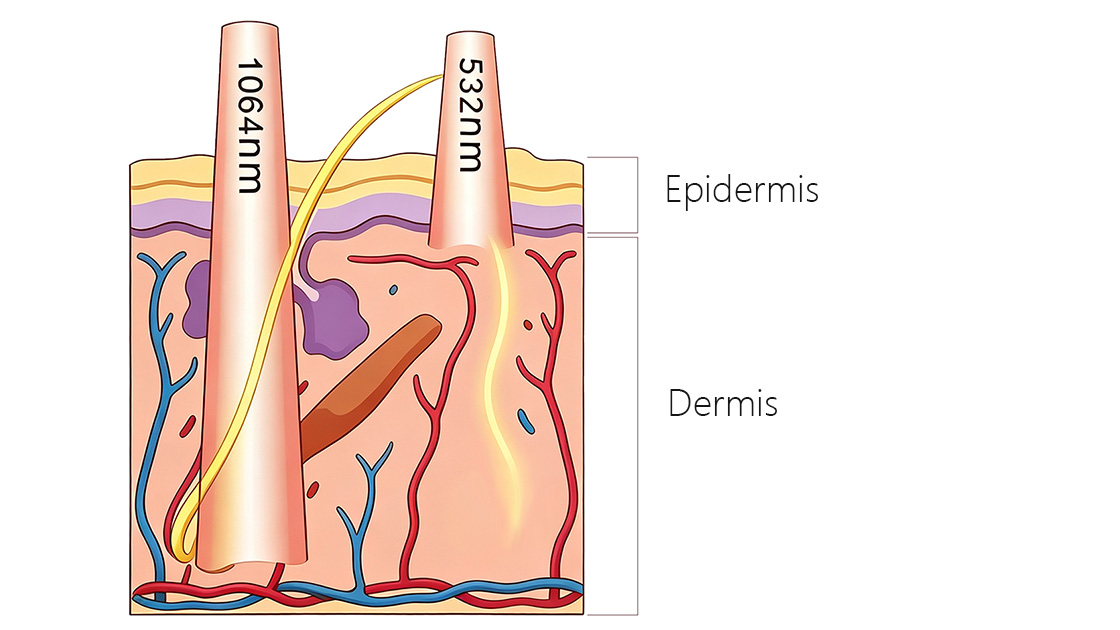
The 1064nm and 532nm wavelengths of Q‑switched lasers exhibit distinctly different physical properties, leading to markedly divergent parameter selection logic and endpoint responses in clinical practice. A thorough understanding of these differences is essential for achieving both efficacy and safety.
1. 532nm Wavelength: Superficial Precision with Strict Energy Control
The 532nm wavelength falls within the yellow‑green spectrum and is strongly absorbed by melanin. Laser energy is largely absorbed by superficial target chromophores within approximately 200‑300μm of penetration, resulting in relatively shallow tissue penetration.
Key clinical features include:
◆ Rapid vaporization of water in the superficial epidermis, often producing immediate frosting (whitening) , purpura, or pinpoint bleeding.
◆ Excessively high fluence may cause tissue splatter, increasing the risk of adverse reactions.
Therefore, energy density should be tightly controlled for 532nm treatments. A recommended starting range is 0.4 ~ 0.8 J/cm², with individualization based on skin phototype:
◆ Darker skin types require lower initial fluence.
◆ Stepwise adjustments should be made in increments of 15% ~ 20% to avoid excessive dose escalation.
2. 1064nm Wavelength: Deep Penetration with Milder Endpoints
The 1064nm near‑infrared wavelength penetrates to the deep dermis (approximately 2‑4mm) with a broader thermal diffusion zone. It is less likely to produce the immediate epidermal effects commonly seen with 532nm.
Primary clinical endpoints include erythema, mild edema, and purpura at the treatment site. In certain indications, mild pinpoint bleeding or superficial crusting is considered a normal therapeutic response.
Initial fluence for 1064nm may be set in the range of 2 ~ 8 J/cm², with the exact value determined by treatment objectives and lesion characteristics:
◆ Darker lesions require lower fluence to avoid excessive absorption and thermal injury.
◆ Endpoint responses should be monitored and adjusted in real time—stronger reactions are not always desirable.
3. Clinical Application References
Blue‑Black Tattoo Removal (1064nm)
Recommended fluence: 3.0 ~ 4.5 J/cm², with immediate frosting as the desired endpoint.
Important note: lighter tattoo colors require higher fluence, and higher energy is recommended for the initial treatment to ensure adequate fragmentation of pigment particles.
Melasma Treatment (1064nm)
A large‑spot, low‑fluence approach is recommended, with parameters set in the range of 1.0 ~ 1.5 J/cm² for optimal safety and efficacy, minimizing the risk of melasma exacerbation.
4. Summary of Key Parameters
|
Wavelength |
Penetration Depth |
Typical Endpoints |
Common Fluence Range |
Indications |
| 532nm | ~200‑300μm | Frosting, purpura, pinpoint bleeding | 0.4 ~ 0.8 J/cm² | Superficial pigmentation, freckles, café-au-lait spots |
| 1064nm | 2‑4mm | Erythema, edema, purpura | 2 ~ 8 J/cm² (Melasma: 1.0‑1.5 J/cm²) | Deep pigmentation, tattoos, melasma |
In clinical practice, treatment parameters should always be guided by real‑time endpoint observation, integrated with patient skin type, lesion depth, treatment site, and individual response—enabling precise, safe, and effective personalized therapy.
上一条:Shengdayu Technology Shines at the 71st Guangzhou Beauty Expo
下一条:Mathematical Relationships in Fluence Settings for Q‑Switched and Picosecond Lasers