

News
In aesthetic medicine, CO₂ laser systems are often described as having two distinct “personalities”: fractional handpieces pursue controlled thermal stimulation, while cutting handpieces pursue precise vaporization and cutting. Both share the same 10600nm laser source but perform fundamentally different clinical tasks.
How It Works: From Beam to “Light Scalpel”
The core function of a CO₂ laser cutting handpiece is to focus the 10600nm infrared beam emitted by the laser through a focusing lens into a microscopic spot with extremely high energy density, instantly heating water molecules in tissue to 100–200°C and producing immediate vaporization. Normal skin contains approximately 20%–35% water—a property that allows 10600nm laser cutting to cause minimal thermal damage to surrounding normal tissue, functioning like a precision “light scalpel.”
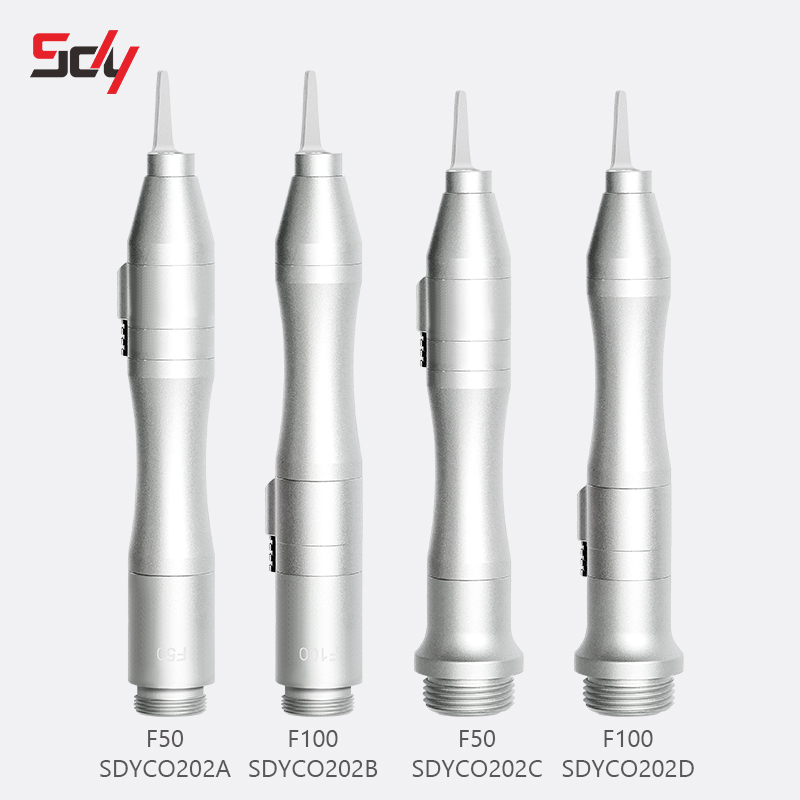
Unlike fractional handpieces, cutting handpieces typically produce a smaller spot—commonly around 0.2mm in clinical practice—to achieve precise cutting with minimal collateral damage. Some systems also offer cutting handpieces with larger spots, such as 1.0mm, for different lesion sizes.
The Clinical Logic of the 10600nm Wavelength: Cut and Coagulate Simultaneously
The unique value of CO₂ laser cutting handpieces in aesthetic surgery stems from the physical property of 10600nm wavelength being efficiently absorbed by water. While vaporizing and cutting tissue, the laser energy simultaneously seals small blood vessels and lymphatics, achieving simultaneous cutting and coagulation, significantly reducing intraoperative bleeding and maintaining a clear surgical field. This is particularly important in the highly vascular periorbital region—conventional cold steel blades cause more bleeding, which can prolong surgery, obscure visualization, and potentially worsen postoperative swelling and bruising. The “bloodless” surgical field provided by CO₂ laser effectively addresses this issue.
Main Clinical Applications
Blepharoplasty and Fine Periorbital Surgery. The use of cutting handpieces in eyelid surgery has substantial evidence support. A study comparing CO₂ laser with 4.0MHz radiofrequency surgery for upper blepharoplasty showed no statistically significant difference in scar aesthetics at 1 year postoperatively, but CO₂ laser demonstrated a clear advantage in intraoperative hemostasis with shorter operative time. Cutting handpieces are typically equipped with micro-spot tips (e.g., 0.2mm, 0.8mm) and combined with continuous wave or ultrapulse modes, performing precise handling of skin, muscle, and orbital septum fat at power settings such as 8W.
Excision of Benign Lesions of the Eyelid Margin and Eyelids. This is another high-frequency scenario for cutting handpieces in aesthetic medicine. It is suitable for precise excision or vaporization of benign lesions including eyelid margin lesions, divided nevus of the eyelid, xanthelasma, syringoma, skin tags, pigmented nevi, and warts. The “light scalpel” in ultrapulse mode provides high cutting precision with minimal damage to surrounding tissue, typically resulting in inconspicuous postoperative scarring. For xanthelasma, CO₂ laser ablation is even regarded by some literature as a “gold standard” level treatment option.
Warts and Cutaneous Growths. Cutting handpieces have a clear role in wart treatment: a 0.2mm tip is commonly used to cut along the skin tangent plane from the base of the wart, followed by a larger spot handpiece (e.g., 2–3mm) to vaporize the base until normal tissue is exposed. For flat warts, a 1mm-class tip is used for precise vaporization, avoiding excessive depth that could lead to scarring.
Cutting Handpieces vs. Fractional Handpieces: Two “Personalities” of the Same Laser Source
The reason a single CO₂ laser device can cover both “rejuvenation” and “excision” scenarios lies in handpiece switching—the laser source itself does not change. The essential difference between cutting handpieces and fractional handpieces lies in the energy delivery method:
Cutting handpieces concentrate all energy into a microscopic spot, achieving “linear” or “spot” continuous cutting and coagulation through tissue vaporization.
Fractional handpieces use scanning galvanometers to disperse the beam into an array of microbeams, creating discontinuous microscopic thermal zones (MTZs) in the skin—pursuing controlled thermal stimulation rather than removal.
The clinical selection logic is clear: when a piece of tissue needs to be excised or vaporized, use a cutting handpiece; when collagen remodeling is needed without tissue removal, use a fractional handpiece.
Selection and Operational Considerations
Several parameters deserve attention in the selection and use of cutting handpieces: spot diameter determines cutting precision and thermal damage range—periorbital fine surgery typically favors 0.2mm-class tips; power and pulse mode must match tissue type and cutting depth—ultrapulse mode concentrates energy with minimal thermal diffusion, helping reduce side effects such as erythema and pain; smoke evacuation is essential during cutting and vaporization—studies have detected viral DNA particles in the smoke produced by laser tissue vaporization, so well-functioning smoke evacuation equipment and proper protection should be in place.
The value of CO₂ laser cutting handpieces lies not in “replacing” fractional handpieces, but in completing the full capability spectrum of CO₂ lasers in aesthetic surgery—from the “reconstruction” of scars and skin texture to the “excision” of lesions and growths. One platform, two roles.