

News
In the clinical application of CO₂ fractional lasers, intimate treatments and skin treatments share the same laser source, yet they face completely different anatomical and physiological realities. Skin is flat, visible, and can be stabilized. The vaginal canal, by contrast, is cylindrical, deep-seated, and requires uniform coverage—yet it is impossible to visually confirm every square millimeter of mucosa. The intimate handpiece exists precisely to resolve this fundamental contradiction: how to deliver a linearly propagating laser beam safely, uniformly, and reproducibly across the entire circumference of a tubular cavity.
Core Design Logic: From “Point-to-Point” to “Ring-to-Wall”
On the skin, fractional handpieces rely on galvanometer scanning to “draw” fractional patterns on a visible flat surface. Inside the vagina, however, the operator cannot watch the laser landing points as they would on skin. If the logic of a skin handpiece were retained, the operator would have to rely on feel to “sweep” or “rotate,” making it nearly impossible to ensure uniform coverage around the 360° circumference—or to avoid repeated exposure or missed areas.
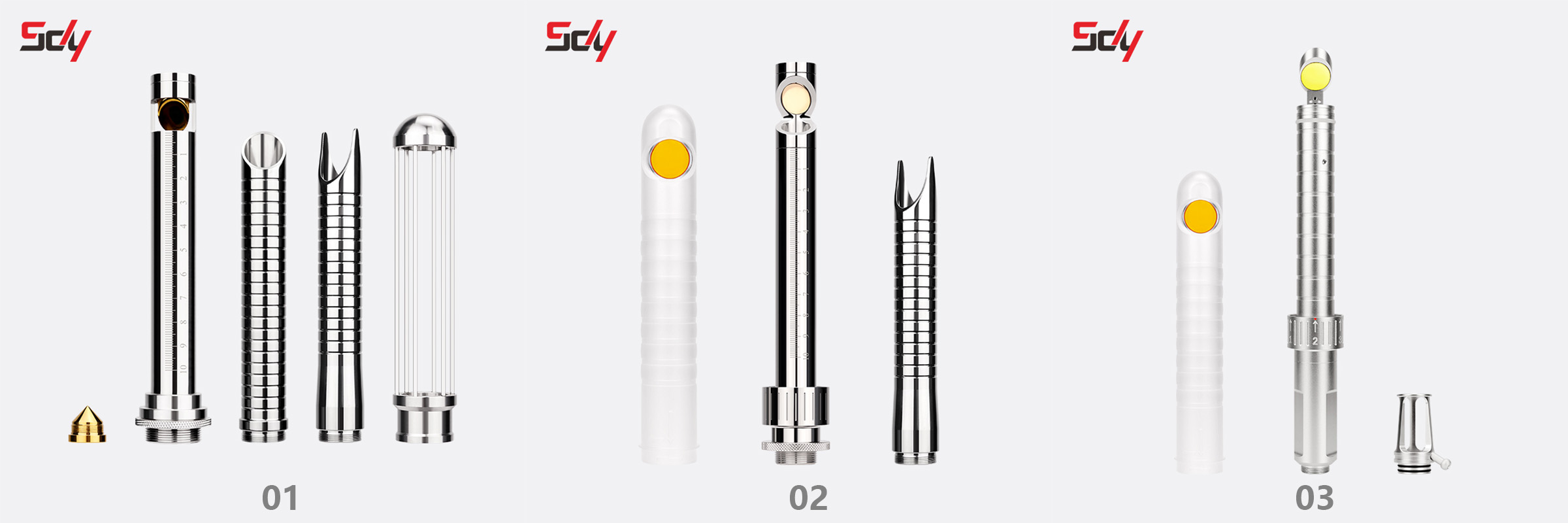
The intimate handpiece solves this by changing the delivery mode from “directional scanning” to “circumferential radial emission.” In a typical design, a 360° reflective surface (often a gold-coated mirror or reflective cone) is positioned at the distal end of the handpiece. The laser beam travels along the handpiece axis and is then uniformly projected onto the surrounding mucosal wall by the reflective surface. This means the handpiece does not need to be rotated inside the vagina; once placed at a specific depth, a single pulse covers the entire circumference at that level. Some designs further distinguish between a 360° probe and a 90° probe: the former for circumferential coverage of the mid-to-lower vaginal canal, the latter for treatment directed toward the urethra or specific focal areas.
Graduated Withdrawal: A Mechanical Solution for Depth Control
Circumferential emission solves “uniformity around the circumference,” but “uniformity along the depth” is another issue. The vagina is a cavity with length; treatment must advance segment by segment from deep to shallow, with consistent energy exposure at each segment and without repeated stacking at the same depth.
The corresponding design is graduated withdrawal combined with scale markings or positioning structures. During treatment, the handpiece is first fully inserted to the predetermined deepest point, then withdrawn outward in fixed increments (typically around 2 cm), with one pulse triggered at each step. The handle usually features scale markings or a limiting sleeve, allowing the withdrawal distance to be objectively controlled rather than relying entirely on feel. The significance of this mechanical constraint is that it partially converts “uniform coverage” from an operator’s experiential judgment into a standardized process that the instrument itself can help achieve.
Depth and Energy: Why Intimate Mode Is a “Gentle Mode”
Vaginal mucosa differs significantly from skin in thickness, water content, and nerve distribution. The laser parameters associated with intimate handpieces typically target a non-ablative or micro-ablative thermal range.
Based on publicly available technical information, the typical penetration depth in intimate mode is on the order of 200–500 μm, with some devices reporting up to approximately 1 mm; the treatment temperature is maintained at around 50–70°C. The goal at this energy level is not tissue vaporization but controlled thermal stimulation, inducing collagen contraction and neogenesis while preserving the integrity of the mucosal surface. Spot spacing is another key parameter: in intimate mode, spacing is often set in the relatively wide range of 0.6–0.7 mm, or even around 1000 μm, to ensure that sufficient healthy mucosa remains between microscopic thermal zones as a source for repair.
Probes Are Not “Universal Parts”: Anatomical Fit Determines Handpiece Roles
Intimate treatment is not a single scenario. GSM-related vaginal mucosal atrophy, postpartum vaginal laxity, vulvar lesions, and symptoms involving the urethral direction correspond to different anatomical regions and treatment depth requirements. Therefore, a complete intimate handpiece set is typically not “one tip for everything,” but includes multiple types such as a 360° vaginal probe, a 90° probe (for the urethra or specific directions), and a vulvar probe. The emission pattern of the vulvar probe differs from that of the vaginal probe because the vulvar surface is visible flat or curved skin; its treatment logic is closer to skin fractional treatment than to circumferential cavity coverage.
The Handpiece Solves “Delivery,” But Not “Evidence”
It should be clearly stated: the engineering precision of intimate handpieces addresses the uniformity, reproducibility, and safety of energy delivery. It enables CO₂ laser energy to act on cavity mucosa in a controlled manner, avoiding uneven coverage or thermal stacking caused by manual operation. This is a technological advance.
But precision in the handpiece does not automatically equate to confirmed clinical efficacy. As discussed earlier, in highly subjective endpoints such as intimate symptoms, the evidence landscape revealed by sham-controlled trials remains complex. The 360° radial emission and graduated withdrawal ensure that “each treatment delivers energy in the same way”; whether that energy can produce improvement beyond placebo at the symptom level depends on indication selection, individual patient differences, and the design of the overall treatment plan.
Prerequisites for Safe Operation
The use of intimate handpieces is highly dependent on standardized technique. Power needs to be adjusted according to anatomical location—deeper vaginal areas may require higher power settings, while the nerve-rich area near the vaginal introitus/vestibule requires lower power to reduce discomfort and injury risk. Stable patient positioning, adequate mucosal lubrication, and strict aseptic technique are all basic conditions for safe delivery. In addition, pregnancy, active infection, and certain uncontrolled systemic conditions are clear contraindications and require evaluation by a gynecologic specialist before treatment.